Tech in Motion — technology powering better performance, smarter features and richer experience

Aerofoil fan blades operate with more breeze, less noise

Aerofoil fan blades are designed with a streamlined cross-section, similar to an aircraft wing. When the fan rotates, air flows smoothly over the curved upper and lower surfaces of the blade. The aerofoil shape creates a gradual pressure difference, resulting in efficient movement of air with more breeze. Because the airflow remains attached to the blade surface for most of its length, flow separation and turbulence are minimised, particularly near the trailing edge. Since turbulence, vortices and unsteady pressure fluctuations are the major sources of aerodynamic noise, reducing them results in quieter fan operation. In addition, an aerofoil blade can generate the required airflow more efficiently and may achieve the desired air delivery at a lower operating power or tip speed — which further reduces aerodynamic and mechanical noise.

How it works

The shape does the work

Two views of the same principle — first the profile, then the airflow it produces.

01

Aerofoil blade cross-section
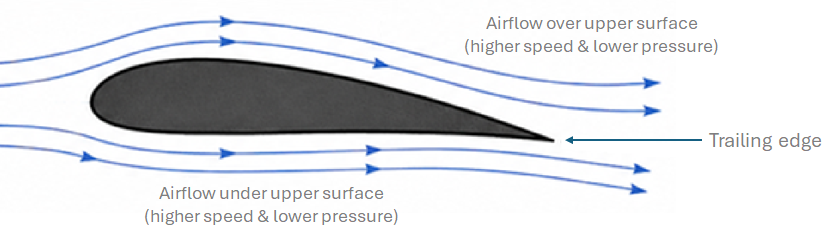

Cross-section of an aerofoil blade with streamlines flowing over and under it. Air over the curved upper surface travels faster at lower pressure; air under the lower surface travels slower at higher pressure, meeting cleanly at the trailing edge.
Air accelerates over the curved upper surface and slows beneath it. The gradual pressure difference moves air efficiently instead of shoving it.
02

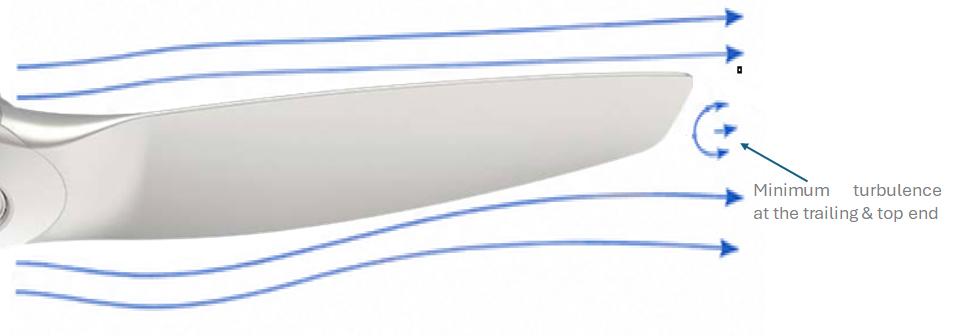
Airflow over an aerofoil blade

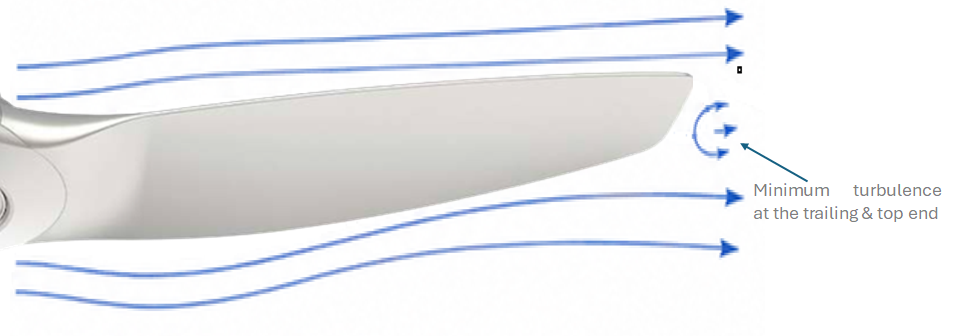
A fan blade with an aerofoil profile. Streamlines stay attached along the full length of the blade, with only minimal turbulence at the trailing and top end.
The flow stays attached along almost the whole blade, leaving only minimal turbulence at the trailing and top end.
  • Smooth, breezy, high airflow
  • Minimum separation and vortices
  • Low unsteady air pressure and fluctuation
  • Less aerodynamic noise, quieter operation

Comparison

Aerofoil blade vs conventional blade

The same air, the same speed — two very different wakes.
Aerofoil blade

Low noise
Aerofoil blade with streamlines remaining attached along its length and minimal turbulence at the trailing edge.
  • Smooth airflow, attached flow
  • Minimal separation and vortices
  • Low unsteady pressure fluctuation
  • Less aerodynamic noise

Conventional flat blade

High noise
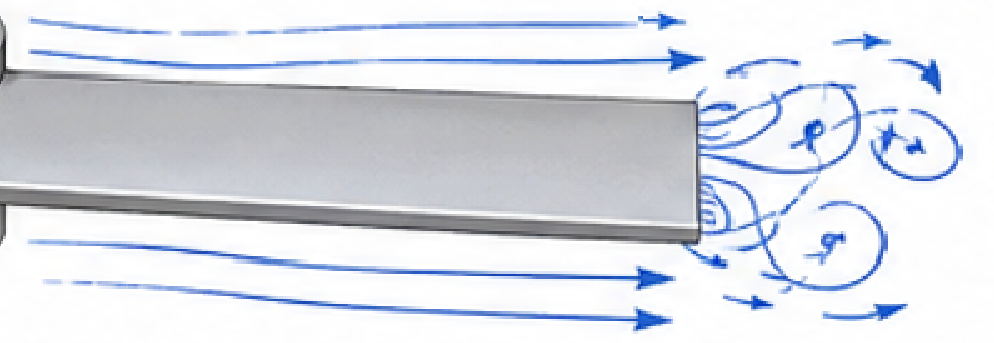
Conventional flat blade with the airflow separating at the trailing edge and breaking into large turbulent vortices behind it.
  • Flow separation at the trailing edge
  • High turbulence and vortices
  • High unsteady pressure fluctuation
  • More aerodynamic noise

At a glance

Full technical summary

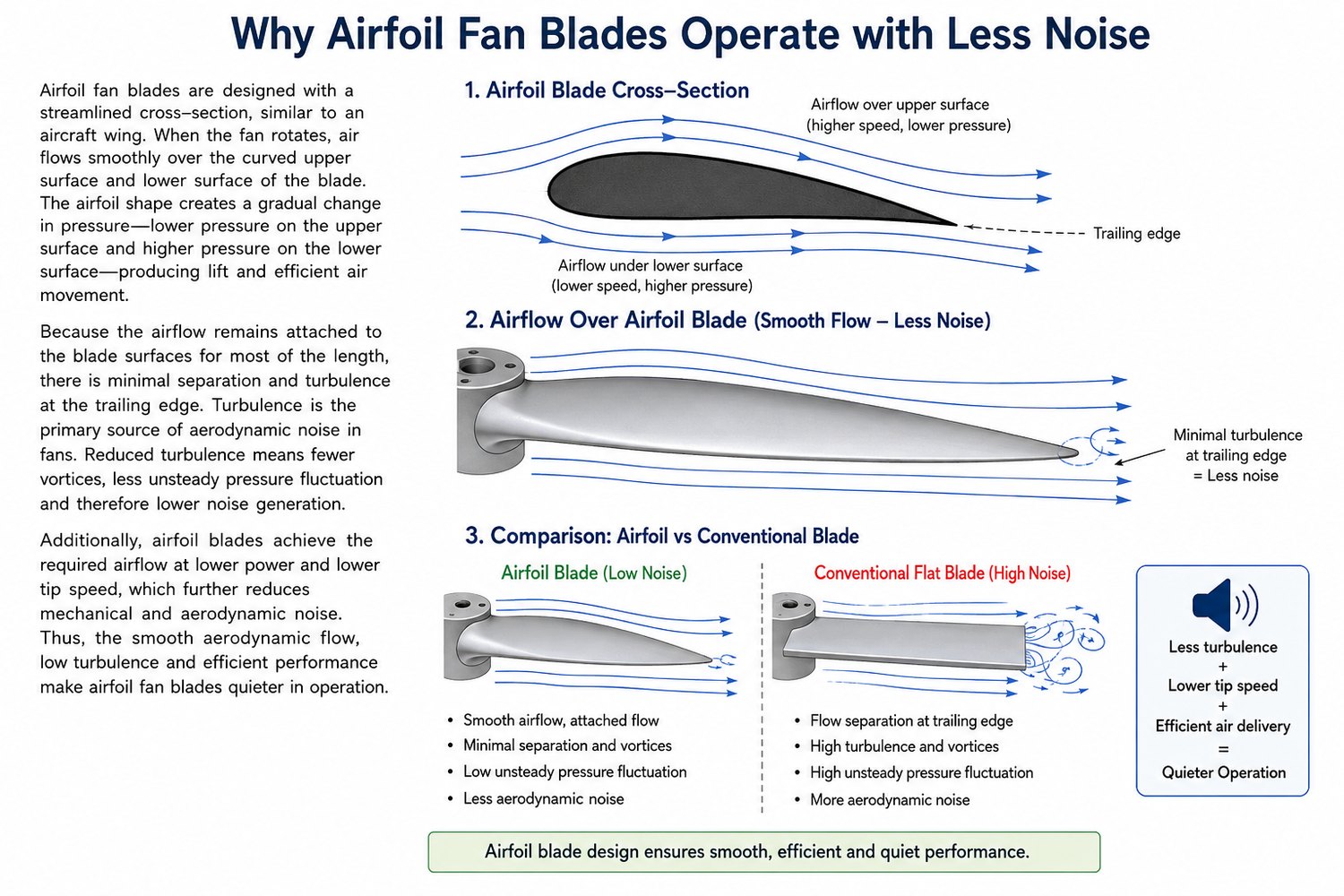
Summary board titled Why airfoil fan blades operate with less noise, combining the aerofoil cross-section, the airflow diagram, and a side-by-side comparison of aerofoil and conventional flat blades with their outcomes.
Aerofoil blade design ensures smooth, efficient and quiet performance.

Conclusion

The streamlined aerofoil profile provides smoother, higher, breezier airflow, reduces flow separation and turbulence, minimises pressure fluctuations, and improves aerodynamic efficiency. Aerofoil fan blades therefore deliver the required airflow with lower aerodynamic noise and smoother operation.

  1. Streamlined aerofoil
  2. Smooth airflow
  3. Less turbulence
  4. Fewer vortices
  5. Lower pressure fluctuation
  6. Less noise